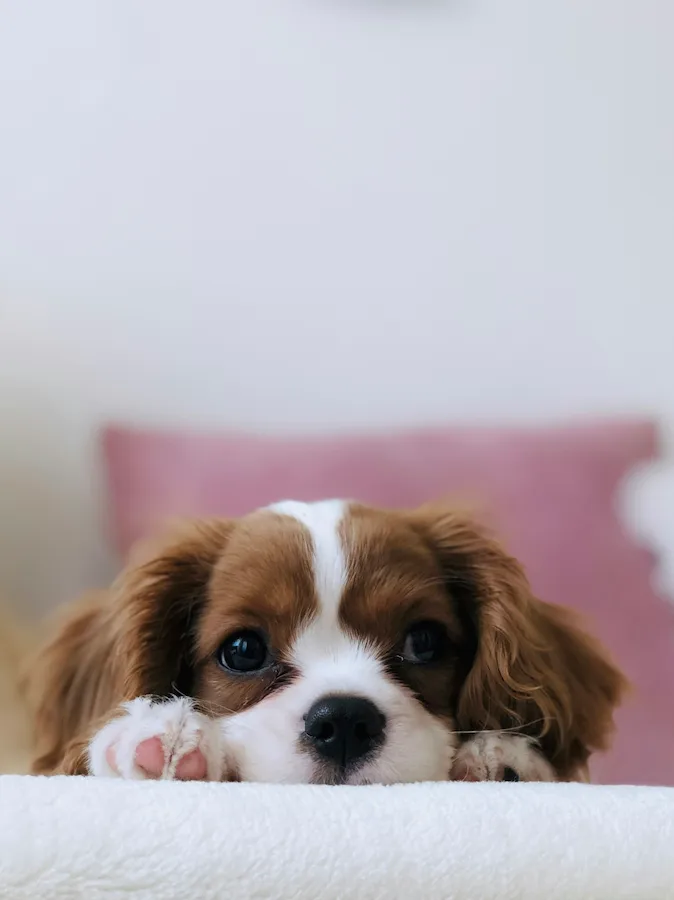
How much do puppies sleep? Hours by age and nap schedule
How much do puppies sleep at each age? A sleep chart by age, a sample nap schedule, why overtired puppies bite more, and where your puppy should sleep.
Quick answer
Puppies 8 to 16 weeks old sleep about 18–20 hours a day, split between nighttime and lots of naps. By 4–6 months that drops to 16–18 hours, and by a year it gets close to an adult’s 12–14. At 8–12 weeks, most can’t stay awake longer than 45–90 minutes without getting overtired and bitey.
In this article
Your puppy tears around the living room for ten minutes, crashes in the middle of the hallway, wakes up, ambushes your ankles, and falls asleep again. If you’re wondering how much puppies sleep and whether all this napping is normal, the short answer is yes: puppies sleep 18 to 20 hours a day during their first few months, and they need every bit of it.
The usual problem isn’t too much sleep but too little. In a new home full of kids, visitors, and toys, many puppies stay awake for hours on end and end up cranky, nippy, and whiny. Below you’ll find typical sleep hours by age, a nap schedule you can copy, the signs of an overtired puppy, and where your puppy should sleep.
How many hours do puppies sleep by age?
These numbers are guidelines: every puppy has their own rhythm, and size, breed, activity level, and health all play a part. What the chart shows well is the trend: lots of sleep early on, then a gradual decline toward the adult pattern somewhere between one and two years of age.
| Age | Total sleep per day | Time awake before needing a nap | Nights |
|---|---|---|---|
| 0–3 weeks | 20–22 hours | Wakes only to nurse | With mom |
| 3–8 weeks | 18–20 hours | Short play sessions with littermates | With mom and littermates |
| 8–12 weeks | 18–20 hours | 45–90 minutes | 1–2 potty breaks |
| 3–4 months | 17–19 hours | 1–1.5 hours | 0–1 potty break |
| 4–6 months | 16–18 hours | 1.5–2 hours | Usually sleeps 7–8 hours straight |
| 6–12 months | 14–16 hours | 2–3 hours or more | Full night |
| Adult | 12–14 hours | Several hours | Full night |
The middle column is the most useful one. A 10-week-old puppy who has been awake for an hour and a half doesn’t need more play: they need a nap, even if they seem to be bouncing off the walls. Large and giant breeds mature more slowly, and many keep needing extra rest for longer.
To compare with how much adult and senior dogs sleep, see how many hours dogs sleep.
Why do puppies sleep so much?
In the first few months, a puppy’s body and brain change at an incredible pace. A medium-size puppy can triple their weight between 8 weeks and 6 months, and all that growth in bones, muscles, and the nervous system takes a lot of energy. Sleep is when the body recovers.
On top of that, every day is packed with new things: smells, sounds, people, surfaces, house rules. Sleep is thought to help sort and store what was learned, as it does in other species, and research in dogs has linked brain activity during sleep after a training session to how well they remember the task later. That’s why a short training session followed by a nap beats a long one with an exhausted puppy.
It’s normal for a sleeping puppy to paddle their legs, twitch, whimper, or flutter their eyelids. These sleep movements are even more common in puppies than in adult dogs. Let them sleep.
How to set up a puppy nap schedule
Puppies don’t self-regulate. Without a set rhythm, they stay awake as long as something interesting is going on and get wound up. What works is repeating the same cycle all day:
- Wake up and go straight outside to potty.
- Active time: play, exploring, low-key socialization, or a 2- to 5-minute training session.
- Meal, if it’s time, followed by another potty break.
- Wind-down: 5–10 minutes with a chew or a lick mat in their rest area.
- Nap somewhere quiet, with no one disturbing them until they wake up on their own.
Here’s what a day might look like for an 8- to 12-week-old puppy. The times are just an example; the back-and-forth rhythm is what matters.
| Time | What your puppy does |
|---|---|
| 7:00 a.m. | Wakes up: potty, breakfast, another potty break, playtime |
| 8:00–10:00 a.m. | Nap |
| 10:00–11:00 a.m. | Potty, socialization or a carried walk, chew toy |
| 11:00 a.m.–1:00 p.m. | Nap |
| 1:00–2:00 p.m. | Potty, lunch, quiet play |
| 2:00–4:30 p.m. | Long nap |
| 4:30–5:30 p.m. | Potty, afternoon meal if on 4 meals, play and training |
| 5:30–7:00 p.m. | Nap |
| 7:00–8:00 p.m. | Potty, dinner (2–3 hours before bedtime), quiet time |
| 8:00–9:30 p.m. | Nap |
| 9:30–10:30 p.m. | Potty, chew toy, calm time |
| 10:30 p.m. | Last potty break and bedtime; 1–2 quick potty trips overnight |
That adds up to about 9–10 hours of naps plus 8–9 hours at night. From around 4 months, awake stretches get longer and naps get fewer, dropping from 5–6 a day to 3–4. By 6 months, many puppies settle into a long morning nap, one after lunch, and one in the late afternoon, plus the night.
Overtired puppies: why a tired puppy bites more
An exhausted puppy doesn’t lie down to rest; they do the opposite. They speed up, race around the house, bark, grab your clothes and ankles, and ignore even their favorite treats. Many owners read this as too much energy and play harder, which makes things worse. It often peaks in the evening, which is why so many people call it the puppy “witching hour.”
These signs mean your puppy needs sleep:
- Increasingly hard bites that don’t stop when you offer a toy.
- Zoomies, frantic laps around the house, often late in the day.
- Barking or whining for no obvious reason.
- Trouble focusing, even for their favorite food.
- Yawning, droopy eyes, or lying down and getting up again over and over.
When you see them, don’t scold and don’t try to tire them out more: a quick potty break, then off to their rest area. If biting is a problem even when your puppy is well rested, how to stop puppy biting has the full plan.
With kids in the house, one rule helps a lot: when the puppy is sleeping, nobody touches or wakes them. Their rest area should be a safe zone.
Where should a puppy sleep?
During the day
For naps, pick a quiet spot that isn’t isolated: an exercise pen with a bed, or a crate with the door open, somewhere without constant foot traffic. Keep it away from drafts, heating vents, and direct sun. Many teething puppies shred their beds, so washable blankets or a simple, inexpensive bed make more sense than a fancy one for now.
At night
For the first few weeks, the most effective setup is having your puppy sleep in your bedroom, close to your bed, in a crate, a pen, or their own bed. You’ll hear them when they need to go out, and it reassures them during their first nights away from their litter. Our guide to puppy crying at night has the full plan for those early nights.
If you use a crate, introduce it gradually and make it pleasant, never a punishment; crate training a dog walks you through it step by step. And if you’re thinking about letting your puppy sleep with you, read up first on whether your dog should sleep in your bed.
How to help your puppy sleep well
Besides protecting naps, these details make a real difference:
- Consistent times for waking up, meals, and bedtime, weekends included.
- Better activity, not more activity: sniffing, exploring somewhere new, or a find-the-treat game tires a puppy out more and winds them up less than endless ball chasing.
- Calm before sleep: chews, lick mats, and stuffed toys help them relax.
- The right setting: dim light, a comfortable temperature, and no blaring TV right next to their bed.
- Teach them to settle on a mat: calmly reward them every time they lie down on it on their own. Over time the mat becomes a cue to rest that you can take to friends’ homes or on trips.
- Don’t keep them awake so they’ll be tired at night. All you get is a cranky puppy who sleeps worse.
All of this fits into the routine of those first weeks, along with potty training, socialization, and early lessons, which we cover in how to train a puppy from scratch.
Sleeping too much or too little: when to worry
A puppy who sleeps a lot but is playful, curious, and eager to eat when awake is doing fine. What matters isn’t just the amount of sleep but how your puppy is the rest of the time. After a vaccine, for example, it’s common for a puppy to sleep a bit more for a day or two.
It’s worth a vet visit if your puppy sleeps very little or very poorly, scratches constantly, can’t get comfortable, cries as if in pain, or snores loudly and seems to struggle for air, which is more common in flat-faced breeds.
If you can’t tell whether your puppy is dreaming or having a seizure, the key difference is that a dreaming puppy wakes up and recognizes you right away when you call their name, while during a seizure the body usually goes stiff and doesn’t respond.
Frequently asked questions
Should I wake my puppy up to pee?
During the day, no: let them sleep and take them out as soon as they wake up, which is when they need it most. At night, during the first few weeks, setting an alarm a little before your puppy usually wakes can prevent accidents. Push it back gradually as long as they stay dry, until they can make it through the whole night.
At what age do puppies sleep through the night?
Most can go 7–8 hours without a potty break by 4–6 months, and many manage it sooner. Size matters (small breeds have smaller bladders), as do dinner timing, the day’s activity, and how well your puppy has settled in. If your puppy still needs several trips out at night at 6 months, mention it to your vet.
Is it normal for my puppy to sleep almost all day?
Yes, as long as they’re active, curious, and hungry when awake. A 2- to 3-month-old puppy is only awake for about 4–6 hours in total, spread out in short stretches. What isn’t normal is a puppy who is listless during those awake periods, doesn’t want to play or eat, or is hard to wake up. In that case, call your vet.
Does music or white noise help a puppy sleep?
It helps some puppies, especially in noisy homes or neighborhoods. In studies with shelter dogs, soft classical music has been linked to more time spent lying down and resting, although the effect may fade as dogs get used to it. Keep the volume low and use it as an extra, not as a substitute for a nap routine and a quiet spot.
Is it okay if my puppy naps on my lap or on the couch?
Once in a while it’s fine, but most naps should happen in your puppy’s own rest area. If they can only fall asleep in your arms, they’ll find it harder to relax when you’re not around, and couches come with a risk of falls. When you see them getting drowsy, move them to their bed or pen so they link that spot with rest.
Sources
- American Kennel Club (AKC): puppy sleep and daily routines.
- Merck Veterinary Manual: puppy development and care, and hypoglycemia in young toy-breed dogs.
- Kis, A., et al. (2017). The interrelated effect of sleep and learning in dogs (Canis familiaris); an EEG and behavioural study. Scientific Reports.
- Wells, D. L., Graham, L., and Hepper, P. G. (2002). The influence of auditory stimulation on the behaviour of dogs housed in a rescue shelter. Animal Welfare.