
Dog aggression: causes, warning signs and how to help your dog
Dog aggression explained: why dogs growl or bite, the warning signs that come first, when to see a vet or behaviorist and how to help without punishment.
Quick answer
Dog aggression is almost always driven by fear, pain, resource guarding or frustration, not a wish to dominate. To help your dog, start with a vet exam to rule out pain, avoid known triggers, never punish growling, and follow a plan from a veterinary behaviorist or a certified trainer who uses reward-based methods.
In this article
- Safety first: what to do starting today
- Why dogs become aggressive
- The warning signs before a bite
- Who can help: your vet, a veterinary behaviorist and a trainer
- How aggression is treated without punishment
- Mistakes that make aggression worse
- Can dog aggression be cured? What to expect
- Frequently asked questions
A growl when you walk past the food bowl, a snap at the vet, or an explosive reaction to another dog on the sidewalk can leave you scared and second-guessing yourself. Dog aggression is one of the most common reasons owners seek help from veterinary behaviorists, and it’s also one of the problems that can improve the most once you understand what’s behind it.
This guide starts with what matters most: keeping everyone safe. Then you’ll see why dogs growl or bite, how to read the signals that come first, which professionals you need, and what you can do at home starting today, without punishment or confrontational techniques.
Safety first: what to do starting today
While you look for professional help, the goal is no more incidents. Every episode puts someone at risk and also reinforces the behavior: your dog learns that growling or biting makes the threat go away.
- Avoid known triggers. If your dog growls while eating, let them eat undisturbed in a separate room. If they react to other dogs, walk at quiet times and in quiet places.
- Never leave kids alone with the dog. Not even for a minute. Either an adult is actively watching, or there’s a door or baby gate between them.
- Guests get a dog-free zone. Put your dog in another room with something to chew, at least until you have a plan.
- Don’t take things away by force. If your dog grabs something dangerous, offer a trade for a high-value treat.
- Muzzle-train with rewards. A basket muzzle lets your dog pant, drink and take treats. With 1–2 weeks of positive associations, most dogs accept it easily. Fabric muzzles that hold the mouth closed are only for very short procedures.
If your dog has already bitten someone, wash the wound with soap and water for several minutes and get medical care. In many US jurisdictions, bites to people must be reported, and the dog is usually observed for 10 days as a rabies precaution; your vet or local animal control can walk you through the steps.
Why dogs become aggressive
Aggression is, above all, communication: “back off,” “don’t touch me there,” “this is mine.” It almost always grows out of a specific emotion (fear, pain, frustration, worry about losing something valuable), and dogs use it when they feel other ways of communicating haven’t worked.
The old idea that an aggressive dog is trying to “dominate” the family is outdated. The American Veterinary Society of Animal Behavior considers dominance theory a poor explanation for these problems and warns that techniques based on it, such as pinning the dog, rolling them onto their back or “being the alpha,” increase fear and the risk of bites.
| Type | Typical situations | Common signs | First step |
|---|---|---|---|
| Fear-related | Strangers, vet visits, handling, new places | Crouched body, low tail, ears back; tries to escape before biting | Give space and never corner the dog |
| Pain-related | Touching a sore spot, lifting, brushing; sudden onset | Turns toward the hand, yelps, limps or is more irritable | Vet exam |
| Resource guarding | Food, bones, toys, the couch, sometimes a person | Freezes over the item, eats faster, growls | Trades; never take things by force |
| Territorial | Doorbell, fence line, guests entering | Barking, charging the door, upright posture | Manage arrivals and visitors |
| Frustration or redirected | On leash seeing another dog, behind a fence | Lunges; may bite whatever is close, including your leg | Distance and reactivity training |
| Between household dogs | Food, narrow hallways, play that escalates | Hard stares, blocking, fights | Separate and get help quickly |
| Maternal | A mother with puppies or in a false pregnancy | Growls when anyone approaches the nest | Respect her space and call your vet |
Many dogs show more than one type. If the problem centers on food or toys, there’s a dedicated plan in our guide to resource guarding in dogs; if it happens on leash around other dogs, see our guide to the reactive dog toward other dogs.
The warning signs before a bite
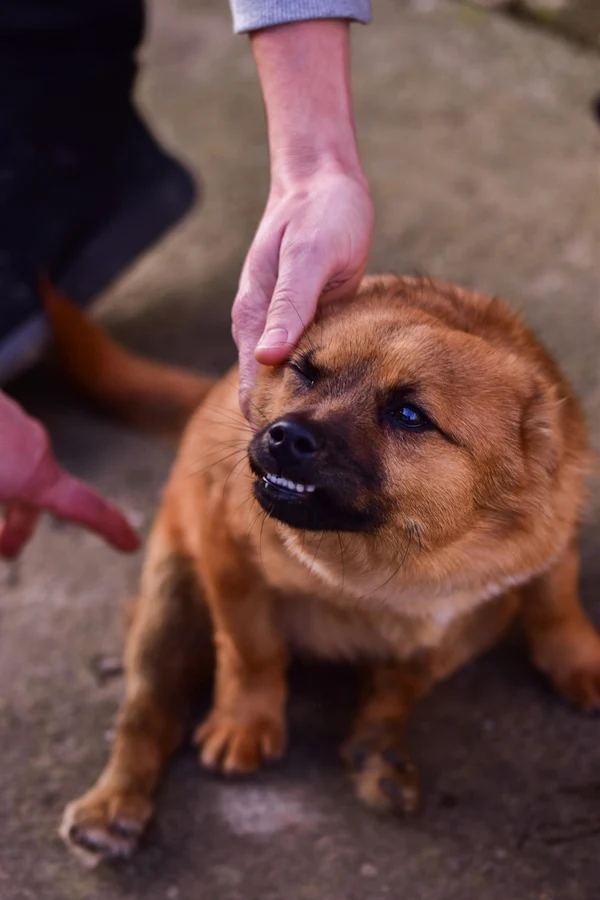
Dogs rarely bite “out of nowhere.” Most first move through a ladder of signals, from subtle to obvious:
- Yawning, lip licking or blinking more than usual.
- Turning the head away, avoiding eye contact or turning their back.
- Moving away, crouching, lowering the tail or pinning the ears back.
- Freezing and stiffening, with a hard stare or the whites of the eyes showing.
- Growling, pulling back the lips and showing teeth.
- Snapping at the air or making contact with the teeth without biting down.
- Biting.
A dog who skips steps isn’t “unpredictable by nature”: often they’ve learned that their subtle signals get ignored or that growling gets punished. Learning to read dog body language lets you step in on the lower rungs, when simply giving space is enough.
Never punish a growl
A growl is an incredibly valuable warning. Punishing it doesn’t remove your dog’s discomfort; it just teaches them not to warn you. The result is a dog who goes straight to biting. When your dog growls, stop what you’re doing, calmly move away and write down the situation: it’s useful information for the behavior plan.
Who can help: your vet, a veterinary behaviorist and a trainer
Aggression is a team effort, and the order matters:
- Your regular veterinarian. A full exam, plus any tests they consider necessary, to rule out medical causes. Joint, ear, dental or skin problems can make any dog irritable; review the signs your dog is in pain before the appointment.
- A veterinary behaviorist. Board-certified veterinary behaviorists (DACVB) diagnose behavior problems, design a behavior modification plan and, when appropriate, can prescribe medication to support treatment. Only a veterinarian can prescribe.
- A certified trainer or behavior consultant who uses reward-based methods. They help you carry out the plan step by step. A good screening question: “What will you do if my dog growls?” If the answer involves corrections, prong or shock collars, or “dominance,” keep looking.
How aggression is treated without punishment
A professional plan usually combines these pieces:
- Management. The safety measures above, kept in place for as long as treatment lasts.
- Desensitization and counterconditioning. Your dog is exposed to the trigger at an intensity low enough that they don’t react, and that exposure gets paired with something great. For a dog who growls at strangers, for example: at 50 feet (15 m), every time a person appears, chicken appears; the person leaves, the chicken stops. You only shrink the distance when your dog stays relaxed.
- Alternative behaviors. Teaching your dog something to do instead of reacting: looking at you, touching your hand with their nose or going to their bed when the doorbell rings.
- Cooperative care. For dogs who react to handling, they learn to accept brushing, nail trims or exams in small steps, with the option to “say no” and pause.
- Everyday well-being. Predictable routines, daily exercise and sniffing, and enough sleep: a tired or stressed dog has less tolerance.
- Medication, if your vet recommends it. It can lower anxiety so your dog is able to learn, but it always goes alongside the plan, never instead of it.
Mistakes that make aggression worse
- Punishing, yelling or leash jerks, and using prong, choke or shock collars. They increase fear and tension around the trigger.
- Confrontational techniques such as forced “alpha rolls,” scruff shakes or staring the dog down. In a survey at a US university veterinary hospital, a substantial share of dogs responded aggressively to these techniques.
- “Getting them used to it.” Pushing your dog close to what they fear or into a crowded dog park (flooding) usually makes them more sensitive, not less.
- Allowing hugs, kisses or kids climbing on the dog. Many dogs barely tolerate them, and they’re a common cause of bites to the face.
- Waiting for it to pass. Without intervention, aggression tends to persist or get worse.
If a new baby is on the way and you’re already seeing tension, start preparing early with our guide on preparing your dog for a baby.
Can dog aggression be cured? What to expect
Many dogs improve dramatically, but talking about a “cure” can set unrealistic expectations. The realistic goal is for episodes to become much less frequent and less intense, and for home life to be safe. Some dogs will need certain management measures for life, much like a person with allergies avoids what makes them sick.
The outlook is usually better when triggers are predictable and avoidable, the dog warns before biting and bites don’t break skin. It’s more guarded when reactions are unpredictable, bites are serious or there are young children at home. Most families see changes within a few weeks and solid progress over several months. In the most serious cases, a veterinary behaviorist will help you weigh all your options honestly.
Frequently asked questions
Are some dog breeds more aggressive than others?
Genetics influences temperament, but breed alone is a poor predictor of bite risk. AVMA reviews point out that early socialization, past experiences, health, handling and supervision matter more. Any dog of any size can bite if they’re scared or in pain and their warnings are ignored, which is why reading individual body language beats breed stereotypes.
Will neutering my dog stop the aggression?
Neutering may help in a few specific cases, such as some hormone-related fights between intact males, but it doesn’t resolve aggression rooted in fear, pain or resource guarding. Results in fearful dogs vary. It’s a decision to make with your veterinarian, based on the type of aggression your dog shows and their overall health.
What should I do if my dog growls at my child?
Calmly separate them without punishing the dog, and note what was happening right before. From then on, use constant supervision or physical barriers. Teach your child not to hug the dog, not to bother them while they eat or rest, and to treat the dog’s bed as off-limits. Then book appointments with your vet and a behavior professional.
Will wearing a muzzle make my dog more aggressive?
Not if it’s introduced well. A basket muzzle paired with treats becomes neutral or even pleasant, and it lets you work calmly in situations that used to be risky. What creates resistance is forcing it on right before something unpleasant. Practice at home first in short sessions, until your dog pushes their nose into it on their own.
Is it safe to adopt a dog who has bitten before?
It can be, if you understand the context of the bite and your home fits the dog’s needs. Ask the shelter what happened, how many times and how serious it was, and consider whether you have kids or frequent visitors. A dog who bit out of fear in one specific situation can live safely with a clear plan.
Sources
- American Veterinary Society of Animal Behavior (AVSAB): position statement on the use of dominance theory in behavior modification of animals.
- American Animal Hospital Association (AAHA): Canine and Feline Behavior Management Guidelines.
- American Veterinary Medical Association (AVMA): dog bite prevention and literature review on the role of breed in dog bite risk.
- Merck Veterinary Manual: aggression and other behavioral problems in dogs.
- Herron, M. E., Shofer, F. S. and Reisner, I. R. (2009). Survey of the use and outcome of confrontational and non-confrontational training methods in client-owned dogs showing undesired behaviors. Applied Animal Behaviour Science.