What makes a quality dog walk: sniffing, pace, long lines, routes
What a quality walk looks like for your dog: time to sniff, a comfortable pace, a long line, varied routes, and a sample 45-minute walk to copy.
Quick answer
A quality dog walk is one where your dog can sniff without being rushed, move at a pace that suits them, explore on a loose leash or a 15- to 30-foot long line, and experience different routes. It isn’t only about minutes: what counts is what your dog gets to do and choose along the way.
In this article
- Routine walk vs. quality walk
- Sniffing: the main ingredient
- Pace: let part of the walk be theirs
- The long line: freedom with safety
- Varied routes and decompression walks
- How to structure a 45-minute quality walk
- Greetings and social contact: less is more
- Safety without stress: what to bring and what to watch
- Frequently asked questions
Plenty of dogs go out three times a day and still come home as restless as when they left. The problem usually isn’t the amount of time; it’s the kind of walk: same sidewalk, short leash, brisk pace, and a tug every time they stop to sniff something. A quality dog walk changes that without adding a single minute.
In this guide you’ll see what separates a routine walk from a quality one, why sniffing is the main ingredient, how to adjust the pace, when and how to use a long line, why varying your routes pays off, and a practical 45-minute walk you can copy.
Routine walk vs. quality walk
How often and how long to walk depends on your dog’s age and energy; we cover that in how often you should walk your dog. Here the focus is on the how: what makes those minutes really count.
| Aspect | Routine walk | Quality walk |
|---|---|---|
| Sniffing | Pulled away when they stop to smell | Time to sniff as much as they like |
| Pace | The human’s, often rushed | Matched to the dog, mixing slow and brisk stretches |
| Leash | Short and tight, or retractable | Loose; long line in open areas |
| Route | Always the same | Varied places and surfaces |
| Choices | The human makes them all | The dog sometimes picks direction and pace |
| Human’s attention | On the phone | Present: watching and engaging |
| Back home | Still restless | Drinks, lies down, and rests |
Not every walk needs to be perfect. Quick potty trips have their place, and we explain the difference in short walk vs. long walk. What matters is that at least one walk a day is a quality one.
Sniffing: the main ingredient
For a dog, sniffing is reading the news, checking social media, and exploring the neighborhood all at once. Their nose has hundreds of millions of scent receptors (up to roughly 300 million depending on breed, compared with about 5–6 million in people), and a large part of their brain is devoted to processing smells.
Sniffing works the brain, and for many dogs it’s also calming. A 2019 study by Duranton and Horowitz found that dogs who did scent work for two weeks afterward showed a more “optimistic” outlook in behavioral tests than dogs who practiced heeling.
How to build more sniffing into your walks:
- Let them stop. If your dog pauses at a lamppost or a bush, wait. A few extra seconds for you is a lot of information for them.
- Head for scent-rich areas: parks, open lots, trail edges, wooded paths.
- Use a release word, like “go sniff,” to tell them they can go explore, and another word to move on (“let’s go”).
- Scatter a few treats in the grass and let them search: two minutes of searching is a solid dose of mental exercise.
Pace: let part of the walk be theirs
Our natural walking speed rarely matches a dog’s. Many large dogs are comfortable at an easy trot, faster than we walk, while small dogs, puppies, and seniors often need a slower pace and more breaks.
A quality walk mixes stretches:
- Slow, for exploring and sniffing, with your dog setting the pace.
- Active, at a brisk walk or a jog, if their age and fitness allow.
- Calm, sitting on a bench watching the world go by. Lots of dogs love people-watching.
Let your dog choose the direction now and then, at intersections for example. Having some control over what happens is good for their welfare, and it shows you what interests them.
The long line: freedom with safety
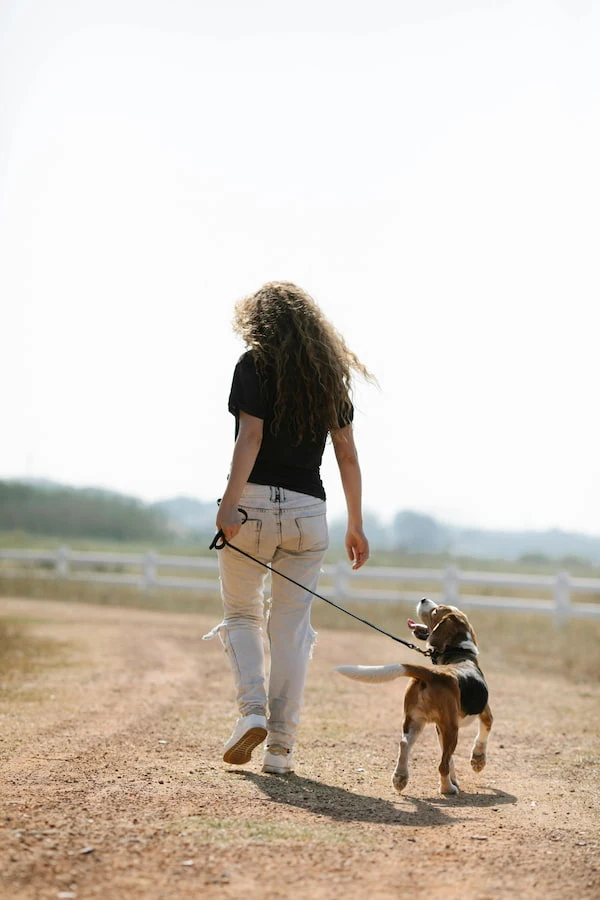
A long line of 15–30 feet (about 5–10 m) lets your dog explore, sniff, and move fairly freely without being off leash. It’s ideal for dogs with an unreliable recall, newly adopted dogs, fearful dogs, and any open area where letting them loose isn’t allowed or isn’t wise.
How to use one well:
- Always clip it to a harness, never a collar: if your dog hits the end of the line at a run, the jolt to the neck can cause injury. If you’re unsure which gear to use, see our harness vs. collar comparison.
- Use it only in open, permitted areas, like large parks, fields, or dog-friendly beaches, not on busy sidewalks. Check local leash laws, since some areas require a 6-foot leash.
- Gather and release it by hand, without wrapping it around your fingers or wrist: a sudden lunge can hurt you. Gloves help.
- Choose a material that doesn’t soak up water, like biothane, so it stays light and clean.
- Watch for tangles with trees, other dogs, or people, and shorten up when someone passes.
Unlike a retractable leash, a long line doesn’t put constant tension on your dog, so it doesn’t teach them that pulling earns more distance.
Varied routes and decompression walks
Walking the same loop is convenient, but a dog who smells the same corners day after day gets less and less out of it. You don’t need to go far: reverse the loop, take a different street, or try another park a couple of times a week.
Vary the surfaces too: dirt, grass, sand, fallen leaves, or gentle slopes enrich the walk and work their muscles and balance.
Once a week, if you can, try a decompression walk: a quiet natural spot with few dogs and people, a long line, and no goal other than exploring. These are especially helpful for anxious, reactive, or newly adopted dogs because they let them dial down their alertness. We look at how this and other types of walks shape behavior in how walks affect dog behavior.
How to structure a 45-minute quality walk
Here’s an example for a healthy adult dog. Adjust the timing to your dog’s age and energy.
- Calm start (5 minutes). Before opening the door, wait a few seconds for your dog to settle. For the first few minutes, let them potty and sniff near home.
- Exploration (15 minutes). Head somewhere with good smells, on a loose leash or long line. Your dog sets the pace.
- Active stretch (10 minutes). A brisk walk, a jog, or a game of fetch or find-it in a safe area.
- Mini training session (3–5 minutes). A recall, a sit before crossing, a treat search. Short and fun, without turning the walk into a class.
- Calm break (3–5 minutes). Sit on a bench or in the grass and watch the world go by.
- Easy return (5 minutes). A relaxed pace so your dog gets home calm.
Greetings and social contact: less is more
A quality walk doesn’t require saying hello to every dog and person. Many adult dogs would rather ignore strangers, and on-leash greetings tend to be tense because neither dog can move freely.
- Always ask before letting your dog approach another dog.
- Keep greetings short, about 3 seconds, and move away cheerfully before tension builds.
- Respect your dog: if they turn away, stiffen, or avoid eye contact, don’t push it.
- If your dog barks or lunges at other dogs, prioritize distance and work on reactivity calmly instead of seeking out encounters.
Safety without stress: what to bring and what to watch
- ID: a tag with your phone number, plus a registered microchip.
- A well-fitted harness: you should be able to slide two fingers under the straps.
- Water and a collapsible bowl in warm weather.
- Poop bags, always.
- Small treats for rewarding and for emergencies (an important recall, a scare).
- Timing based on weather: in summer, early morning and late evening.
Frequently asked questions
Will letting my dog sniff everything make them less obedient?
No. Sniffing is a need, not a whim, and a dog who gets to satisfy it is usually calmer and more attentive. The key is clear rules: one word that gives permission to sniff and another to move on. That turns sniffing into a reward you control, and your dog learns that paying attention to you opens the door to what they love most.
How long should a quality walk be?
For most adult dogs, 30 to 60 minutes is a good range for the main walk of the day, though high-energy dogs may need more. Content matters more than the clock: twenty minutes of relaxed exploring in a park can give your dog more than an hour of speed-walking down the same sidewalk.
Can I use a retractable leash instead of a long line?
It’s not the best option. A retractable leash keeps constant tension on your dog, so they learn that pulling buys more distance, and the thin cord can cause burns and cuts if it wraps around legs or fingers. The brake also handles a sudden lunge poorly. A flat long line gives you more control and clearer communication.
Is it better to always walk the same route so my dog feels safe?
For very fearful or newly adopted dogs, a familiar route provides security at first. Over time, though, variety is enriching: introduce changes gradually, like a new street or a quiet park, and watch how your dog responds. If they explore with curiosity and come home relaxed, you’re on the right track.
What should I do if my dog eats things off the ground on walks?
Teach “leave it” at home, starting with low-value items, then practice outside. While your dog is learning, keep the leash shorter in areas with food litter and carry high-value treats to trade. If your dog eats things compulsively, talk to your vet and consider positively conditioning them to wear a basket muzzle.
Sources
- Duranton, C. and Horowitz, A. (2019). Let me sniff! Nosework induces positive judgment bias in pet dogs. Applied Animal Behaviour Science.
- RSPCA: guidance on walks, exercise, and enrichment for dogs.
- American Kennel Club (AKC): guides on canine scent, walking, and long-line use.
- American Veterinary Society of Animal Behavior (AVSAB): position statement on humane dog training.