Signs of stress in dogs: how to spot them and what to do
The signs of stress in dogs, from subtle to severe: a table of 15 signals, how to tell stress from other causes and when to call your veterinarian.
Quick answer
The most common signs of stress in dogs are yawning or lip licking out of context, panting without heat or exercise, ears pinned back, a low tail, showing the whites of the eyes, trembling and refusing food. When you see them, move your dog away from the trigger, and if they’re frequent or sudden, talk to your vet.
In this article
- What stress is in dogs and when it becomes a problem
- The most common signs of stress: a quick-reference table
- Mild, moderate and severe: how stress escalates
- How to tell stress from other causes
- Signs of chronic stress: when it lasts for weeks
- What stresses dogs the most
- What to do when you see signs of stress
- Frequently asked questions
Your dog yawns in the vet’s waiting room, licks their lips when a child hugs them, or shakes off like they just climbed out of a pool right after passing a big dog. These gestures are so quick that most people miss them, but they’re signs of stress in dogs, and learning to spot them lets you step in before your dog is truly overwhelmed or reacts with a growl.
In this guide you’ll find a table of the most common signals and what else they might mean, how to tell stress apart from other causes, what long-term stress looks like, and what to do the moment you notice it.
What stress is in dogs and when it becomes a problem
Stress is the body’s response to something a dog perceives as a threat, a change or a challenge. Hormones like adrenaline and cortisol are released, preparing the body to flee, defend itself or freeze. In small doses it’s normal and useful: a vet visit or distant thunder triggers acute stress that fades fairly quickly.
It becomes a problem when it’s intense, frequent or prolonged. Chronic stress is linked to digestive upset, lick wounds, behavior changes and a lower quality of life. There’s also a pattern worth knowing about, often called trigger stacking: a dog who has already dealt with fireworks, a houseguest and a walk full of dogs may overreact to a fourth trigger that wouldn’t have bothered them on a calm day.
The most common signs of stress: a quick-reference table
No single signal means much on its own: context is everything. Use this table to recognize the signs and rule out other explanations.
| Signal | What it looks like | It could also mean |
|---|---|---|
| Yawning | Out of context, during an interaction or in a new place | Sleepiness or fatigue, especially after waking up |
| Lip or nose licking | A quick flick of the tongue over the nose or lips | They just ate or smell food |
| Panting | Mouth open with tense, pulled-back corners, no heat or exercise | Heat, exercise, pain or a breathing problem |
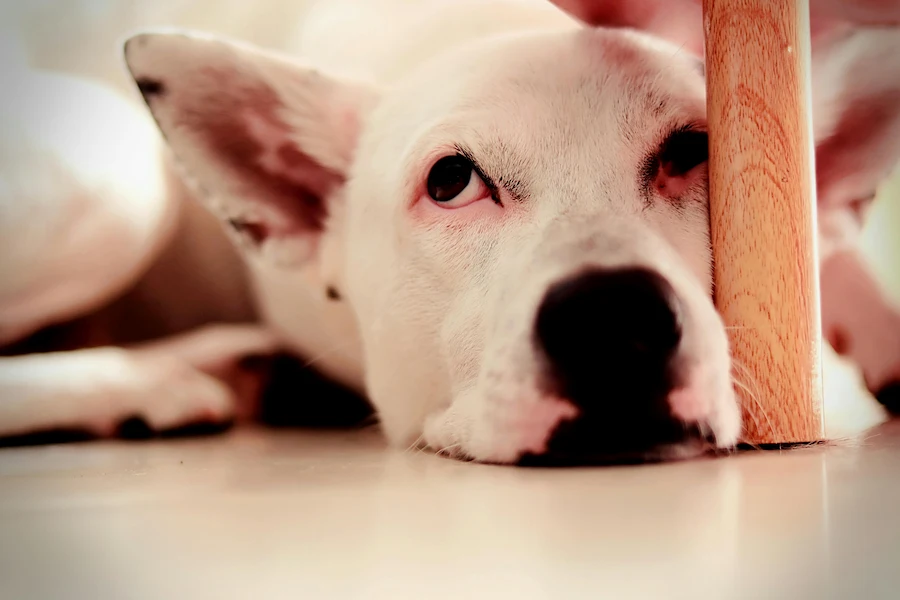
| Whale eye | Head turns away but the eyes stay fixed, showing the whites | Rarely neutral: almost always signals discomfort |
| Dilated pupils | Very dark eyes even in good light | Dim light or high excitement during play |
| Ears pinned back | Flat against the head or constantly swiveling | A friendly greeting if the body is loose |
| Low or tucked tail | Lower than usual for that dog | Breeds with naturally low tails, like greyhounds |
| Trembling | Shaking when it isn’t cold | Cold, pain, nausea or illness |
| Shaking off | Like shedding water, right after something tense | After a bath or getting up from a nap |
| Sudden scratching | In the middle of a greeting or a training exercise | Itching from fleas, allergies or dry skin |
| Raised front paw | With the body still and tense | Focus or “pointing” in hunting breeds |
| Sweaty paws | Damp paw prints on the vet’s exam table | A hot room |
| Sudden shedding | Lots of loose hair all at once during a vet visit | Seasonal shedding |
| Refusing treats | Won’t take food they usually love | Nausea or simply being full |
| Tuning out or sniffing the ground | Suddenly sniffs instead of greeting | Normal exploring if the dog is relaxed |
Here’s a handy test on walks: offer a treat your dog adores. If they won’t take it, or snatch it roughly, they’re probably too stressed to think, and it’s time to move away.
Mild, moderate and severe: how stress escalates
Signals tend to show up in a fairly predictable order:
- Mild. Yawning, lip licking, turning the head, blinking, sniffing the ground, moving slowly. Many of these are known as calming signals, a term popularized by Norwegian trainer Turid Rugaas: the dog is trying to lower the tension in the situation.
- Moderate. Ears back, low tail, crouched body, panting, whale eye, trying to move away or hide behind you.
- Severe. Stiffening, intense trembling, trying to escape, growling, showing teeth, urinating or expressing the anal glands (a strong, distinctive smell).
The sooner you step in, the easier it is for your dog to calm down. If severe signals show up often and end in growling or snapping, it’s no longer just a stress problem: read our guide to dog aggression and how to help.
How to tell stress from other causes
Three questions will help you interpret what you’re seeing:
- What just happened? A yawn after a nap is sleepiness; the same yawn when a stranger leans over your dog probably isn’t.
- Are several signals showing up together? One lip lick says little. Lip licking, ears back, a low tail and a stiff body all at once is a clear message.
- Is this normal for your dog? Know their baseline: how they carry their tail, ears and body when they’re relaxed at home. Stress shows up as a change from that baseline.
Stress and pain share many signs: panting, trembling, stiffness, irritability, hiding. If you can’t find an obvious trigger, review the signs your dog is in pain. To read the rest of the body in more detail, see our guide to dog body language.
Signs of chronic stress: when it lasts for weeks
Ongoing stress doesn’t always show up as one specific gesture. More often, it appears as changes that creep in gradually:
- Destructive behavior, especially when left alone.
- Excessive licking or chewing of paws or flanks, sometimes with sores or reddish-brown staining on light fur.
- Repetitive behaviors: tail chasing, spinning, barking at nothing.
- Sleeping poorly or always being on alert, even at home.
- Appetite changes and diarrhea that comes and goes.
- Startling at every noise or reacting to things they used to ignore.
- Peeing in the house without a urinary problem.
- Withdrawing, or the opposite, refusing to leave your side.
What stresses dogs the most
- Loud noises: fireworks, thunderstorms, construction. If that’s your dog, we have a specific plan for the dog afraid of fireworks and thunder.
- Being left alone, especially without gradual practice. Start with our guide on how to teach your dog to stay alone.
- Vet and grooming visits, particularly handling and slippery surfaces.
- Changes at home: moving, renovations, a new baby or pet, schedule changes.
- Too little activity, or too little rest. A day with no sniffing or play is stressful, and so is not getting enough sleep: adult dogs typically need around 12–14 hours of sleep and rest a day.
- Forced interactions: hugs, kids chasing them, being picked up, or dogs crowding them at the park.
- Punishment and unpredictable environments, where your dog never knows what’s coming next.
What to do when you see signs of stress
In the moment:
- Add distance from whatever is bothering your dog: cross the street, turn around or move to another room.
- Don’t force or scold. Speak calmly and offer contact if your dog seeks it. Comforting a scared dog doesn’t reinforce fear: it helps them feel safe.
- Offer something that lowers arousal: scatter treats in the grass to sniff out, a snuffle mat or a lick mat.
- Give them a safe spot: a quiet corner away from foot traffic, where no one bothers them.
- Write down what happened. Time, trigger, signals and how long it took to settle. That log is gold for spotting patterns and for your vet or trainer.
Long term, the key is reducing triggers, keeping routines predictable and teaching your dog to relax. We walk through it step by step in how to calm a stressed dog.
Frequently asked questions
Does yawning always mean my dog is stressed?
No. Dogs yawn when they’re sleepy, waking up or stretching, just like we do. A yawn counts as a stress signal when it happens out of context: during an uncomfortable interaction, in the vet’s exam room or while being scolded. Also check whether it comes with other signals, such as ears back, lip licking or a tense body.
Can a dog wagging its tail be stressed?
Yes. Tail wagging signals emotional arousal, not necessarily happiness. A high, stiff tail with short, fast movements can go along with tension or alertness, and a low tail wagging quickly can signal insecurity. Read the tail together with the rest of the body: a happy dog wags in wide, loose sweeps with a relaxed body.
How long does it take a dog to recover after a scare?
It depends on the dog and how intense the scare was. Many dogs bounce back within minutes, but after a big fright it can take hours to fully settle, and some stay more sensitive for a day or two. During that time, avoid demanding situations and stick to calm walks, sniffing games and plenty of rest.
Can stress make my dog sick?
Chronic stress is linked to recurring diarrhea, poor appetite, skin damage from licking and flare-ups of some existing health problems. Acute stress can also cause short-lived diarrhea, for example after a trip or a stay at a boarding kennel. If digestive signs last more than 24–48 hours or you see blood, call your veterinarian.
Do pheromone diffusers or calming supplements work?
The evidence is limited and results vary a lot from dog to dog. They may help as an add-on in some cases, but they don’t replace identifying and managing the cause of the stress. Check with your veterinarian before buying a supplement: some products interact with medications, and not all have research supporting their effectiveness.
Sources
- American Animal Hospital Association (AAHA): Canine and Feline Behavior Management Guidelines.
- Fear Free Pets: resources on signs of fear, anxiety and stress in dogs.
- Merck Veterinary Manual: normal social behavior and behavioral problems of dogs.
- RSPCA: guidance on recognizing stress and fear in dogs.
- Rugaas, T. On Talking Terms with Dogs: Calming Signals. Dogwise Publishing.