How to teach your dog to sit, step by step
Teach your dog to sit with positive reinforcement: the lure method, how to fade the treat, when to add the cue, common mistakes, and a week-by-week plan.

Quick answer
To teach your dog to sit, hold a treat at their nose and slowly move it up and back over their head: as they follow it, their rear end drops. Mark with “yes!” and reward instantly. After 5–6 reps, use an empty hand and add the word “sit.” Many dogs learn the hand signal in 1–3 five-minute sessions.
In this article
- Why “sit” should be the first cue you teach
- What you need before you start
- How to teach a dog to sit, step by step
- Another option: capturing the sit
- Training plan: what to expect week by week
- Common mistakes when teaching sit
- How to use sit in everyday life
- When sitting is hard for your dog
- Frequently asked questions
“Sit” is almost always the first cue a dog learns, and for good reason: it’s easy, you can get it in a few minutes, and it comes in handy a dozen times a day. Even so, plenty of dogs only sit when they can see the cookie, or sit perfectly in the living room and ignore you at the park. Knowing how to teach a dog to sit the right way from the start prevents those sticking points.
This guide walks you through the lure method in four phases, an alternative for dogs who get too wound up around food, a week-by-week plan, the most common mistakes, and what to do if sitting is physically hard for your dog.
Why “sit” should be the first cue you teach
Sitting is something your dog already does on their own many times a day, so all you have to teach is doing it when you ask. That makes it the perfect cue for your dog (and you) to learn how training works: I do something, I hear the marker, the reward shows up.
It’s also a very practical self-control tool. A sitting dog can’t jump on guests, bolt out the door, or lunge at the food bowl. That’s why it’s the foundation for cues like “stay” and “down,” and the first step in the rest of the basic dog commands.
What you need before you start
- Small, soft treats, pea-sized for small dogs and about dime-sized for big dogs. They should take a second to eat and leave no crumbs. If your dog is very food-motivated, you can use part of their daily kibble.
- A marker word such as “yes!” or “good!” that you say the instant their rear touches the floor. If you want even more precision, clicker training works just as well.
- A quiet spot with non-slip footing. On tile or hardwood, many dogs avoid sitting, so put down a rug or a towel.
- The right timing: not right after a meal (treats won’t interest them) and not when they’re bouncing off the walls. Right after a short walk is usually perfect.
Keep sessions short: 2–3 minutes for puppies and 5–10 minutes for adult dogs, once or twice a day. Treats should stay under 10% of your dog’s daily calories.
How to teach a dog to sit, step by step
Phase 1: lure with a treat
- Stand or kneel in front of your dog (kneel if they’re small), holding a treat between your thumb and fingers.
- Bring the treat to their nose, about half an inch (1–2 cm) away, and let them sniff it.
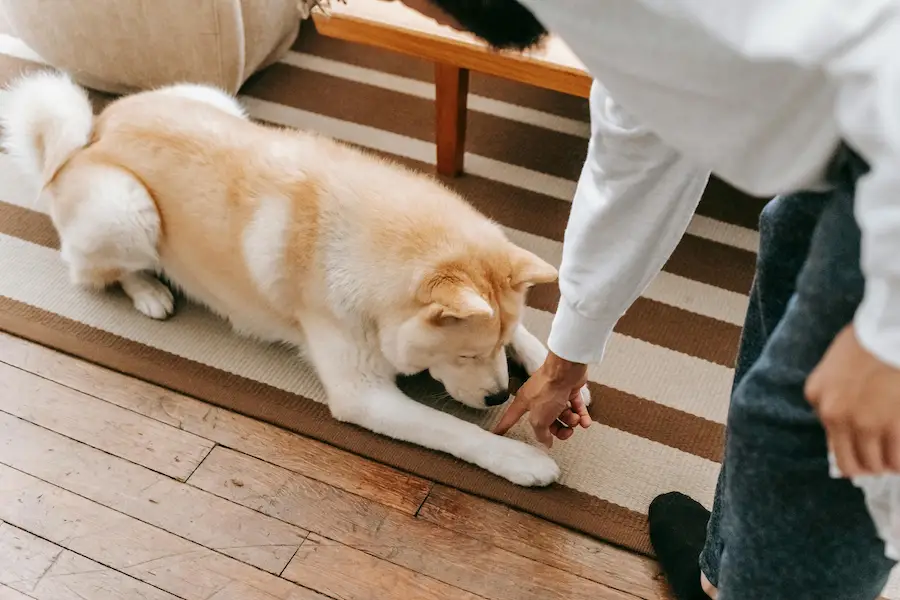
- Slowly slide your hand up and slightly back over their head, toward their ears. As they lift their nose to follow the scent, their rear end will drop on its own.
- The instant their rear hits the floor, mark (“yes!”) and give the treat right at their mouth while they’re still sitting.
- Say your release word (“free!” or “okay”) and take a step back so they stand up. Repeat 5–10 times.
If your dog jumps for the treat, your hand is too high: keep it glued to their nose. If they back up instead of sitting, practice with their back end near a wall or in a corner of a hallway.
Phase 2: fade the treat from your hand
Once your dog sits 5–6 times in a row following the treat, make the exact same motion with an empty hand. When they sit, mark and pull a treat from your other hand or your treat pouch. This step is what prevents the dog who “only listens when they see food.”
Over the next few days, shrink the motion until it’s a short upward sweep of your hand, palm facing the ceiling. That becomes your hand signal for “sit.”
Phase 3: add the word “sit”
When your dog responds to the hand signal 8 out of 10 times, say “sit” once in a normal voice, pause for a second, and then give the hand signal. After a number of repetitions, your dog will start sitting when they hear the word, before your hand moves. That’s the moment to throw a party.
Don’t say the word at the same time as the hand signal: dogs pay much more attention to your body than to your voice, so they’ll tune out the sound.
Phase 4: duration, distance, and distractions
Now it’s time to make the sit rock-solid. Raise the difficulty one variable at a time:
- Duration: wait 2 seconds before you mark, then 5, then 10. Reward while they’re still sitting.
- Distance: cue the sit from one step away, then two.
- Distractions: another person in the room, a toy on the floor, the backyard, a quiet street, the park.
When you raise one variable, lower the others. Holding a sit for several seconds is actually the beginning of teaching how to teach a dog to stay.
Another option: capturing the sit
Some dogs get so worked up with food in front of their face that they jump, mouth your hand, or bark. For them, capturing works better: stand still with treats in your pouch and wait. Sooner or later your dog will sit on their own. That second, mark and reward; then toss a treat a few feet away so they get up and you can start again.
Within a few sessions, you’ll see your dog plop into a sit in front of you on purpose, “offering” the behavior. Then add the word the same way as in phase 3. Capturing is a bit slower at first, but it builds a dog who thinks for themselves instead of following a lure.
Training plan: what to expect week by week
| Week | Goal | Move on when… |
|---|---|---|
| 1 | Sit by following the treat, then with an empty hand | Your dog sits 8 out of 10 times on the hand signal |
| 2 | Respond to the word “sit” at home | Sits within 2 seconds with no hand signal |
| 3 | Hold the sit 5–10 seconds with mild distractions | Stays put even when someone walks past |
| 4 | Sit in the yard, on the sidewalk, and at friends’ homes | Responds in at least 3 different places |
From week 3 on, stop rewarding every rep: reward 3 out of 4, then at random, and swap some food rewards for real-life ones (opening the door, throwing the ball). Never stop rewarding completely.
Common mistakes when teaching sit
- Pushing down on their rear end. Dogs naturally push back against pressure, it can be uncomfortable for their hips, and they don’t learn to do it on their own.
- Repeating the cue. “Sit, sit, SIT!” teaches your dog that the real cue is the third one, said loudly.
- Rewarding late. If the treat arrives after they’ve popped back up, you’re rewarding standing up.
- Always showing the food. If the treat is visible on every rep, your dog learns sitting is only worth it when they can see it.
- Sessions that run too long. Anything past 10 minutes drains focus; a puppy checks out after 2–3.
- Skipping the release word. Without one, your dog decides when the sit is over.
How to use sit in everyday life
A cue gets stronger when you use it in real situations, as your dog’s polite way of saying “please”:
- Before you open the front door or the car door.
- Before you put the food bowl down.
- Before you throw the ball or start a game of tug.
- While waiting at a crosswalk.
- When greeting guests: sitting is incompatible with jumping, which is why it’s the key to stopping your dog from jumping on people.
The point isn’t to control your dog’s every move; it’s to give them a simple, clear way to get what they want.
When sitting is hard for your dog
Not every dog sits with the same ease. Sighthounds such as greyhounds and whippets are built in a way that makes sitting less comfortable, and many prefer to stand or lie down. In that case, accept a “stand-stay” or teach your dog to lie down instead.
With very young puppies, the issue is usually attention span, not ability: do one-minute sessions several times a day.
Frequently asked questions
At what age can a puppy learn to sit?
As soon as they come home, usually around 8 weeks old. Puppies learn quickly when sessions last 1–3 minutes and treats are tiny so they don’t fill up. At that age, don’t worry about precision: you just want them to link the position with good things. Reliability around distractions comes over the following months as you practice in different places.
What if my dog only sits when they see a treat?
Go back to phase 2: use the hand signal with an empty hand and only pull the treat from your pouch or pocket after they sit. Also mix up the type of reward (food, play, petting, getting to go outside) and practice when you’re not carrying treats, rewarding with something your dog wants in the environment. The food dependence usually fades within a week or two.
Can I teach my dog to sit without food rewards?
Yes, although it’s usually slower. Dogs who love to play can learn with a toy as the reward: they sit, you throw the ball. You can also capture the behavior and reward it with petting or access to something they want. Praise on its own doesn’t motivate most dogs much at first, but it works well when combined with other rewards.
Should I say “sit” or “sit down”?
Either works, as long as the whole family uses the same one and it sounds different from your other cues. Just be careful with “sit down” if you also use “down” for lying down, because your dog may mix them up. Teach the hand signal too: it’ll be a lifesaver if your dog loses some hearing in their senior years.
Why does my dog sit at home but not outside?
Because dogs don’t generalize well: to them, “sit in the kitchen” and “sit at the park” are almost different behaviors. Outside you’re also competing with smells, dogs, and people. Every time you change locations, start over with higher-value treats and lower expectations, then raise the difficulty gradually.
Sources
- American Kennel Club (AKC): sit training guides and the Canine Good Citizen program requirements.
- American Veterinary Society of Animal Behavior (AVSAB): position statement on humane dog training methods.
- ASPCA: guidance on positive reinforcement training.
- RSPCA: advice on reward-based dog training.