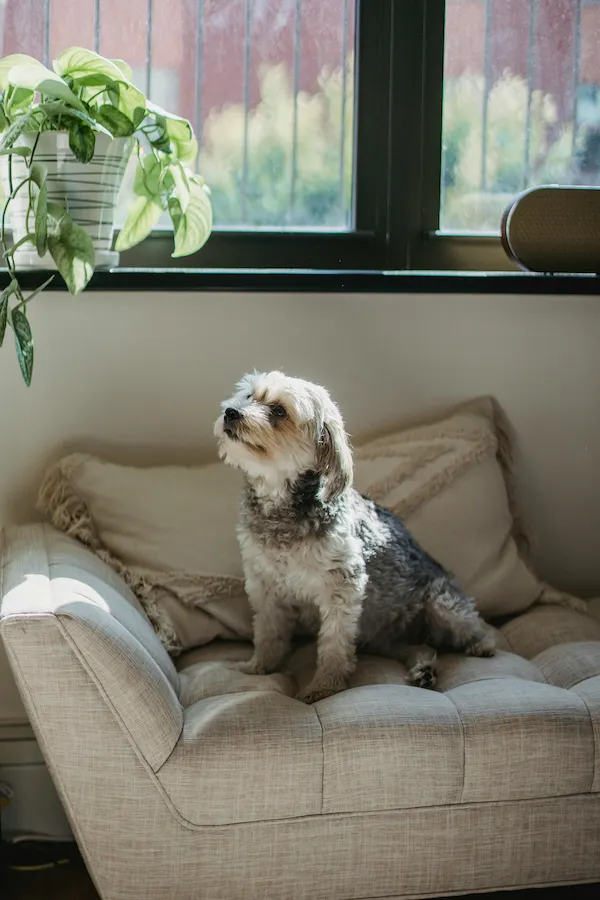
Why does my dog follow me everywhere? Causes and what to do
Why your dog follows you everywhere, even to the bathroom: attachment, learning, breed, or anxiety. How to tell normal from a problem and what to do.
Quick answer
Your dog follows you because you’re their main source of safety, food, play, and company, and because following you usually pays off. It’s normal as long as they can relax when you’re out of sight. Talk to your vet if they panic when left alone, if the change is sudden, or if an older dog seems confused.
In this article
- The most common reasons your dog follows you everywhere
- Is it normal for my dog to follow me to the bathroom?
- When following becomes hyper-attachment or separation anxiety
- If your dog suddenly started following you: possible health causes
- How to help your dog become more independent
- Mistakes that make clinginess worse
- Frequently asked questions
You head to the kitchen and they’re right behind you. You get up for a glass of water and there they are again. You close the bathroom door and find them lying against it when you come out. If you’ve ever wondered why your dog follows you everywhere, the short answer is that you’re the center of their world: food, walks, play, and a big part of their sense of safety all come from you.
Most of the time, it’s perfectly normal. But some dogs shadow their owners out of distress rather than interest, and others suddenly start doing it because something has changed in their health. Below you’ll find the most common reasons, a table to help you tell normal from worrying, and a step-by-step plan to build your dog’s independence without taking away any of the affection.
The most common reasons your dog follows you everywhere
There’s rarely just one cause. Usually a few of these overlap.
You’re their attachment figure
Dogs are social animals that have lived alongside people for thousands of years. When researchers adapted the “Strange Situation” test, originally designed to study attachment in young children, they found that many dogs form a genuine attachment bond with their main person: they seek that person out when something worries them, explore more confidently when that person is around, and greet them enthusiastically after a separation. Other research has linked mutual gazing between dogs and owners to a rise in oxytocin in both.
Following you is the easiest way to keep that “secure base” close. That’s why many dogs follow one person in particular: whoever feeds them, walks them, or simply spends the most hours with them.
You’ve (accidentally) taught them it pays off
Think about what happens when your dog trails you into the kitchen: sometimes a scrap falls on the floor, you talk to them, you give them a scratch, or you end up heading out for a walk. Every one of those outcomes reinforces the behavior. A dog who follows you isn’t being needy for no reason. They’ve learned that the action happens wherever you are.
Their breed was built to work beside you
Some breeds were developed over generations to work closely with a handler: herding dogs like border collies and Australian shepherds, pointing breeds like the Vizsla, retrievers like the Labrador, and many companion breeds such as the Chihuahua. There’s a reason people call them “velcro dogs.” Even so, individual personality and training matter more than breed.
Curiosity, boredom, or not enough to do
A dog who spent the morning with nothing to do will follow you because you’re the only entertainment in the house. If their needs for walks, sniffing, and play aren’t being met, every move you make looks like a promise that something fun is about to happen.
They want something specific
Sometimes the following has a clear goal: it’s almost dinnertime or walk time, they need to go potty, the water bowl is empty, or their favorite toy rolled under the couch. If your dog follows you and also stares at you, heads to the door, or sits by their bowl, they’re telling you what they need.
They’re scared or unsure
Thunderstorms, fireworks, a move, construction next door, a new baby: in new or stressful situations, many dogs look for the person they trust most. Newly adopted dogs also tend to stick close to their new family for the first few weeks.
Something has changed physically
A dog who suddenly starts shadowing you, especially an older dog, may be losing their sight or hearing, may be in pain, or may be showing early signs of cognitive decline. More on that below.
Is it normal for my dog to follow me to the bathroom?
Yes, in most cases. What matters isn’t that your dog follows you, but how they feel when they can’t. A dog with healthy attachment tags along, but if you close a door, they lie down and wait calmly. A hyper-attached dog pants, whines, or scratches at the door until you reappear.
Use this table to see where your dog falls:
| Sign | Normal following | Possible problem |
|---|---|---|
| You close a door | Lies down and waits, or goes to their bed | Whines, barks, scratches, or pants nonstop |
| You get ready to leave | Watches you with interest | Gets agitated, trembles, or presses against your legs |
| Left home alone | Rests; may bark briefly | Howls, destroys things, has accidents, or drools |
| You come home | Happy greeting that settles quickly | Frantic excitement that lasts for minutes |
| When it started | They’ve always been like this | Came on suddenly or got worse within days |
| The rest of the day | Plays, eats, and sleeps normally | Eats less, seems restless, or sleeps poorly |
If your dog mostly fits the middle column, there’s nothing to “fix.” Enjoy the company, and if you’re tired of tripping over them, teach them to settle on a bed (we’ll show you how below).
When following becomes hyper-attachment or separation anxiety
Hyper-attachment is an excessive dependence on one person: the dog needs that person in sight to feel calm. It often goes hand in hand with separation anxiety, an emotional problem that shows up when the dog is left alone or separated from their attachment figure.
These are the most common signs:
- Follows you from room to room and never really rests, even when you’re sitting still.
- Gets anxious at your departure cues: picking up keys, putting on a coat or shoes.
- When left alone, barks, howls, or whines nonstop, destroys things near doors and windows, has accidents in the house, or drools heavily.
- These behaviors usually start within the first 30 minutes after you leave.
- Greets you like you’ve been gone for a week, even if you just took out the trash.
If several of these sound familiar, the independence plan in this guide is a good start, but it usually isn’t enough on its own. Separation anxiety needs gradual work with very short absences, which we cover in our guide on teaching your dog to stay home alone. To recognize when your dog is struggling, it also helps to know the signs of stress in dogs: panting when it isn’t hot, yawning out of context, lip licking, or pinned-back ears.
If your dog suddenly started following you: possible health causes
A sudden change in behavior always deserves attention. If your dog was never clingy and now won’t leave your side, consider these possibilities:
- Pain or discomfort. Some dogs in pain seek more company; others withdraw. Watch for limping, trouble getting up, panting at rest, or licking one spot over and over.
- Vision or hearing loss. A dog who can’t see or hear as well relies on you more to stay oriented and may startle when they can’t find you.
- Cognitive decline. In older dogs, canine cognitive dysfunction can cause confusion, changes in sleep, nighttime vocalizing, and a constant need for contact. You’ll find more tips in our senior dog care guide.
- Hormonal changes. Some unspayed females get extra cuddly during heat or a false pregnancy.
- Changes in your own life. Many owners notice their dog sticking closer during an illness, a pregnancy, or a stressful stretch. Dogs pick up on changes in routine and mood, although science hasn’t pinned down exactly what they detect.
How to help your dog become more independent
The goal isn’t to make your dog want you less. It’s to help them relax when you’re out of sight. Work in 3–5 minute sessions, once or twice a day, at times when your dog is already calm: after a walk, not right before one.
- Meet their needs first. Walks with time to sniff, play, and age-appropriate mental exercise. A satisfied dog follows a lot less.
- Set up a comfy spot. A bed or mat in a quiet area where, at first, they can still see you. Make it a great place to be: that’s where treats, chews, and calm petting happen.
- Reward calm when you see it. Whenever you spot your dog lying down and relaxed away from you, walk over without fuss, drop a treat between their paws, and go back to what you were doing. They learn that resting on their own pays off too.
- Teach them to stay on their bed. Send them to the bed, reward, take one step back, and reward again. Slowly add distance and duration. If you need the basics, follow our guide on how to teach a dog to stay.
- Practice tiny separations. Use a baby gate: you in the kitchen, your dog on the other side with a stuffed food toy. Start with 10–30 seconds and only build up if they stay relaxed.
- Make your movements boring. Get up, grab your keys, and sit back down several times a day. Once your routines stop predicting anything, your dog stops monitoring them.
- Keep hellos and goodbyes low-key. Short, calm greetings when you leave and when you come home. Big homecoming parties sharpen the contrast between “you’re here” and “you’re gone.”
In dogs without separation anxiety, daily practice usually brings visible progress within 2–4 weeks: less shadowing, longer stretches on the bed, and no more jumping up every time you shift in your chair.
Mistakes that make clinginess worse
- Scolding or shooing them away. It makes your dog less secure and, with it, more determined to keep an eye on you.
- Suddenly ignoring them completely. Cutting off all contact overnight is confusing and frustrating. Giving attention when they’re calm works far better than withholding it all the time.
- Leaving them alone for hours “so they get used to it.” Throwing an anxious dog into long absences without preparation usually makes things worse.
- Answering every request. If every stare or paw tap gets petting, your dog learns that pestering works. Mix it up: sometimes respond, sometimes send them to their bed and reward them there.
- Being the only caregiver. When other family members feed, walk, and play with the dog, the attachment gets shared and no single person becomes the dog’s lifeline.
If you want a strong but healthy relationship, our guide on how to bond with your dog has activities that build trust without building dependence.
Frequently asked questions
Why does my dog follow me and not anyone else in the family?
Usually because you provide the most good stuff: meals, walks, play, or simply more hours together. Your style matters too, since dogs tend to gravitate toward the person who feels most predictable and calm. If you’d like to spread the attachment around, ask other family members to take over some daily routines, such as the evening meal or the morning walk.
Why does my dog lie right next to me or on my feet?
Seeking physical contact while resting is an affiliative behavior: many dogs sleep leaning against their companions. It may also help them notice when you get up, or simply keep them warm. If their body is loose and their breathing slow, it’s contentment. If they’re tense and staring at the door, check their body language for signs of unease.
Is a dog who follows their owner everywhere happier?
Not necessarily. Following you shows attachment, but a well-adjusted dog can also rest alone, explore, and entertain themselves. Independence doesn’t reduce affection: a dog who trusts you’ll come back can stay calm in another room and still greet you with the same joy. The real concern isn’t wanting to be near you; it’s being unable to relax when you’re not there.
Should I let my dog follow me into the bathroom?
If it doesn’t bother you and your dog is calm, there’s no harm in it. If you want privacy, close the door matter-of-factly and give them something to do first, like a chew on their bed. What doesn’t help is flip-flopping, letting them in one day and scolding them for trying the next, because that inconsistency makes them more unsure.
Why does my puppy follow me everywhere?
That’s completely normal. Puppies instinctively follow their mother and littermates to feel safe, and once they come home, you fill that role. Use this stage to teach them, little by little and with rewards, that they can also be fine on their own for a few minutes in their space. It’s one of the best ways to prevent separation problems in adulthood.
Sources
- ASPCA: guidance on separation anxiety in dogs.
- Merck Veterinary Manual: behavior problems in dogs, including separation anxiety and cognitive dysfunction.
- American Kennel Club (AKC): information on canine behavior and breeds known for staying close to their owners.
- Topál, J. et al. (1998). Attachment behavior in dogs (Canis familiaris): a new application of Ainsworth's Strange Situation Test. Journal of Comparative Psychology.
- Nagasawa, M. et al. (2015). Oxytocin-gaze positive loop and the coevolution of human-dog bonds. Science.